Key facts
- Official text confirms dynamic weather, seasons, and time of day.
- Footprints can be tracked through snow and mud.
- Demo Update #1 moved darkness to around 9 PM instead of 6 PM; sleeping from 6 PM still skips to the next day.
- Some missions, conversations, events, and infected may only appear under specific time or weather conditions.
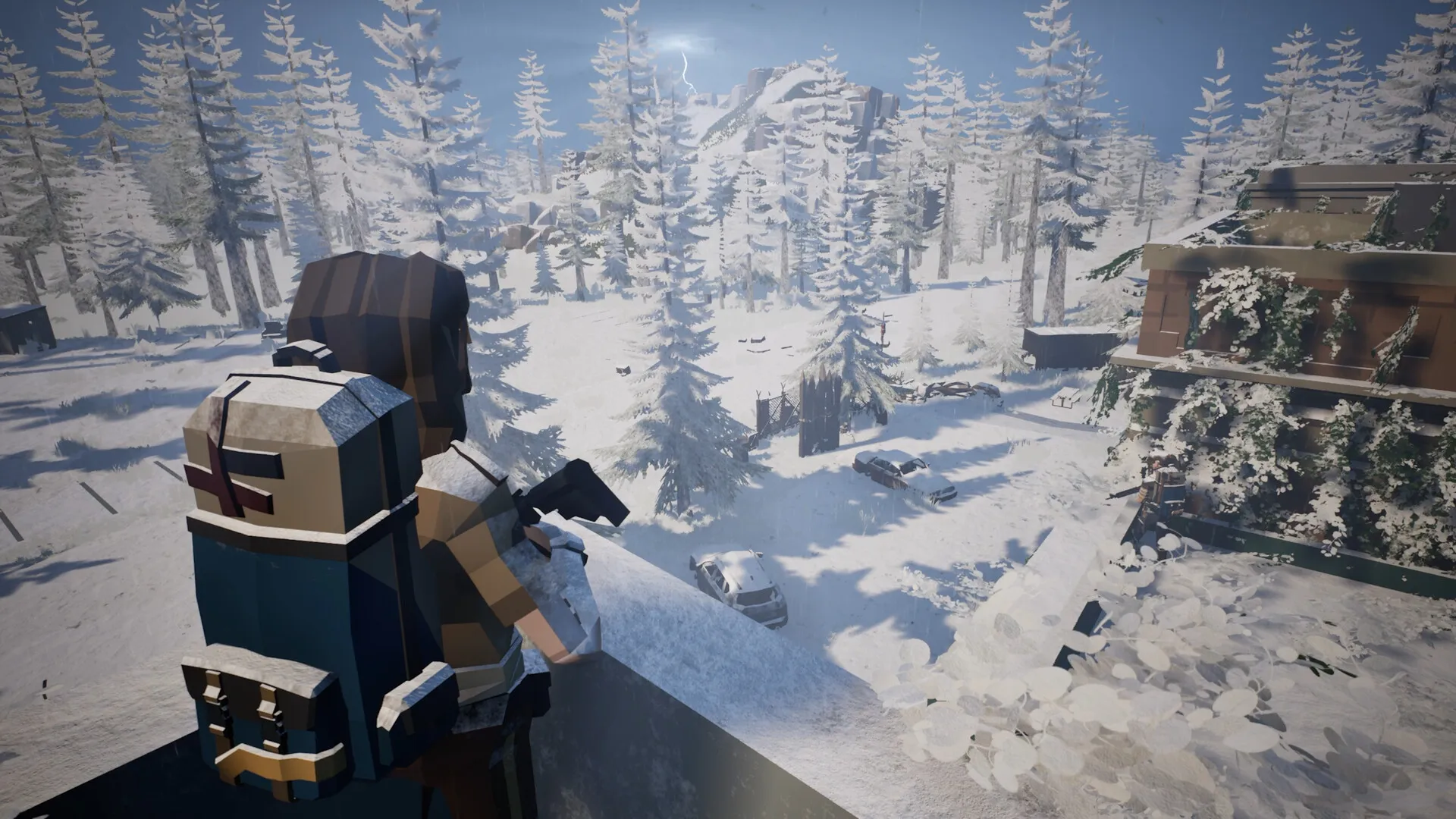
Never Be Alone’s weather is not a cosmetic overlay. The official feature list says snow, rain, fog, storms, and changing light affect visibility, exploration, and combat. It also says footprints can be tracked through snow and mud, poor weather can help you move unseen, and certain missions, conversations, events, and infected may only appear under specific conditions.
That makes time and weather a planning layer on top of the map. The question is not only “where am I going?” but “when is it worth going, and when can I get back?”
The daylight window changed
Demo Update #1 moved darkness from roughly 6 PM to roughly 9 PM. That is a meaningful quality-of-life change:
- You have roughly three more hours of usable light.
- A late supply run is less of a commitment.
- The trip home after dusk becomes the real decision, rather than the whole afternoon being a countdown.
Sleeping from 6 PM still skips to the next day. If you want to move the clock forward, that option remains; if you want the extra light, you now have it.
Weather as a tool
The official text frames poor weather as an opportunity as well as a hazard. Use it deliberately:
- Fog and heavy rain reduce visibility for you and for the infected. They are a good time to move through open ground, and a bad time to identify a silhouette at range.
- Snow and mud preserve footprints. That cuts both ways: you can track a patrol or a wounded animal, and something can track you.
- Storms are a noise event. They cover movement and make it harder to hear what is close.
- Cloud cover affects solar power. A base that depends on solar panels is a base that depends on the forecast.
Do not treat bad weather as a free stealth mode. It reduces information for everyone, including you.
Time-gated content
The store page confirms that some missions, conversations, events, and infected may only appear under specific conditions. That is a strong hint for completionists:
- If a character has nothing new to say in the morning, try the evening.
- If a mission marker is not appearing, check whether the objective depends on time or weather.
- If you are hunting a specific infected, night is a different spawn context, not just a darker version of day.
- Do not assume a missed conversation is a bug. It may be a condition you have not met.
Beast Studios has not published the full condition table. Treat any “do this at exactly 3:14 AM” guide as unverified unless it cites the build it tested.
The practical day plan
A day in Never Be Alone has four useful phases:
Morning: admin and short trips
- Check the fields, water, and storage.
- Sort loot and repair gear.
- Take a short local run while the light is stable.
- Talk to survivors; morning dialogue may differ from evening.
Midday: the main expedition
- Take the long route, the vehicle, or the multi-building POI.
- Carry food, water, and a bandage.
- Set a turn-back time before you leave, not when you are already tired.
Late afternoon: the return
- Start moving home while you still have full daylight.
- Do not start a new POI after the light begins to turn.
- If a vehicle is involved, this is when you want to be on the known road.
Night: defense and interior work
- Stay near the safezone or a defensible position.
- Use interior time for crafting, storage, and conversation.
- If you go out, use the light deliberately and keep the route short.
- Treat the Night Roarer as a reason to have an exit, not a reason to stand still.
Power and weather
Official text says power production reacts dynamically to time of day, weather, and cloud cover. That is a direct link between the sky and your base:
- Solar panels are strongest in clear daylight and weakest under cloud.
- A generator is weather-independent and noisy.
- A base with critical powered systems needs either a backup or a plan for a cloudy week.
The base building guide covers placement and the noise trade.
What is still unknown
- Season length and whether seasons change crop or spawn behavior.
- Temperature effects on the player, if any.
- Whether there is a weather forecast or only observation.
- Exact time gates for missions and conversations.
- Whether sleeping is always available or only at certain hours.
- Whether Night Roarer spawns are random, conditional, or story-driven.
Those are real gaps. A weather guide that fills them with exact numbers is guessing.
Night checklist
- Route home known without the flashlight.
- Food, water, and a bandage.
- Weapon loaded, light attached, noise plan understood.
- A defensible position identified.
- A reason to be out that is worth the exit problem.
If you cannot tick all five, the correct plan is to stay in and sort storage.
Last verified
2026-11-19
This guide combines official Beast Studios information with clearly labelled demo observations. Where the public record is empty, the page says so. See the editorial policy and the full source list.